
Debrief
The problem isn’t AI. It’s content with no author.
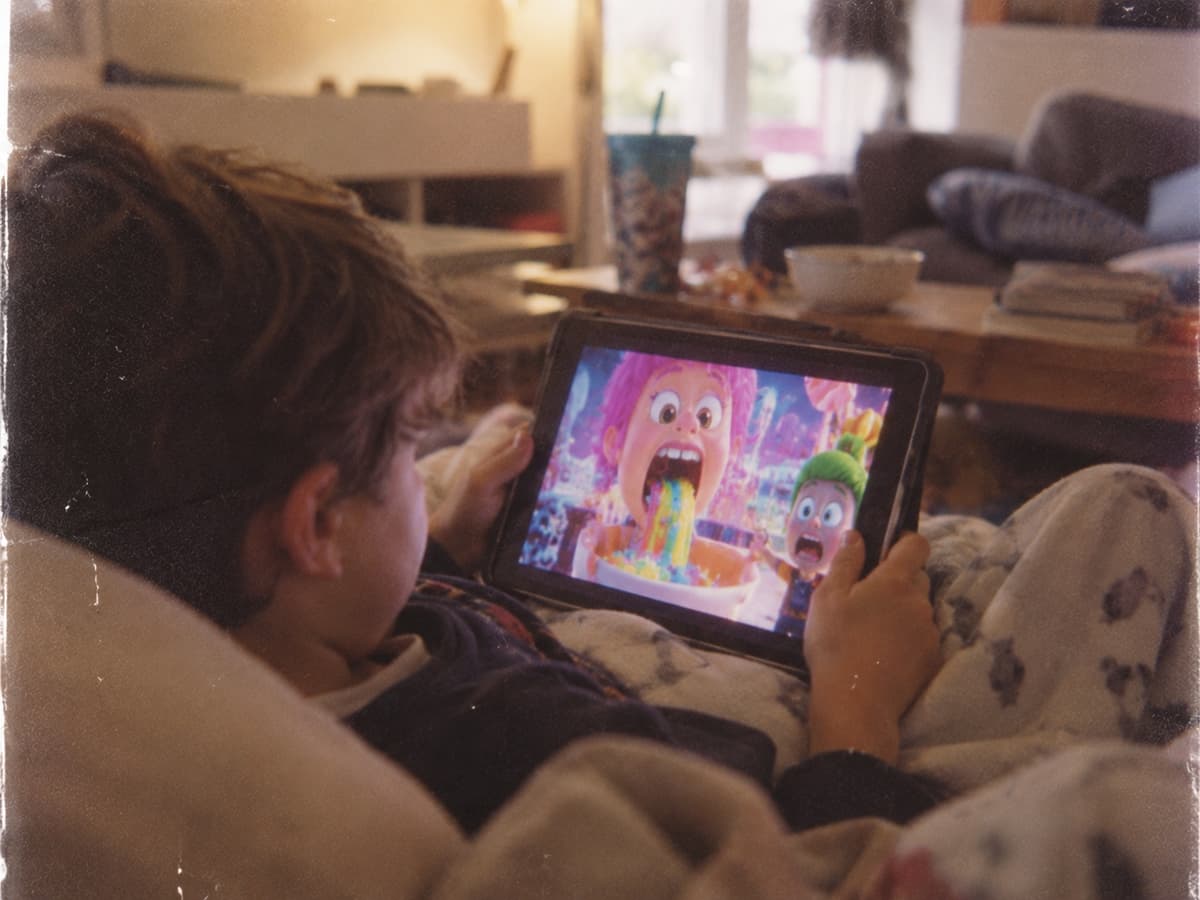
AI-generated kids’ content is scaling faster than the editorial systems around it. For Famdom, the real divide is not human versus machine. It is authored, accountable content versus volume with nobody meaningfully responsible for what a child sees.
AI should expand an author’s capability, not remove the author from the responsibility.
What we found
On 1 April 2026, more than 230 organisations and experts signed a Fairplay letter asking YouTube and Google to act against what they call “AI slop” for children.
Their concern was not theoretical.
The letter cited reporting that 40% of recommendations following popular preschool shows on YouTube contained AI-generated content, and that around 21% of recommended Shorts shown to new users included low-quality AI material.
The coalition asked YouTube to label AI-generated content clearly, remove it from YouTube Kids, stop recommending it to under-18s and give parents a way to switch it off.
YouTube has pushed back on the idea that all AI-generated content is equivalent. The company says YouTube Kids limits AI-generated material to a small set of high-quality channels, and CEO Neal Mohan has made reducing low-quality, repetitive AI content one of YouTube’s explicit 2026 priorities.
That distinction is where the interesting question begins.
The Famdom read
We do not think “AI-generated” is the useful dividing line.
A human creator can make disposable content. An AI-assisted team can make thoughtful, beautiful work.
The more useful distinction is authorship.
Who decided why this piece should exist? Who chose what the child should feel, learn or imagine? Who checked whether the story made sense? Who is responsible if it misleads, overwhelms or simply wastes a child’s attention? Who says no when the algorithm says more?
If the answer is nobody, the problem is not that AI was used.
The problem is that production has been separated from responsibility.
Children’s attention is not free inventory
AI radically lowers the cost of producing another video.
That can be creatively liberating.
It can also make abundance almost frictionless.
When content is created for children, that changes the economics of attention in a particularly sensitive way. A child does not experience the marginal cost of another generated episode. They experience colour, sound, repetition, characters and the recommendation that appears next.
The platform sees another unit of content.
The family experiences another claim on the child’s time.
That is why volume cannot be treated as a neutral production achievement.
The author still matters even when the tools change
Authorship does not mean one person drawing every frame by hand.
It means someone carries intention and responsibility through the work.
A writer can use AI. An animator can use AI. A director can accelerate production with AI. A studio can use audience data and generative tools to test, iterate and improve.
What matters is whether the technology sits inside a creative system with judgement.
Animaj offers a useful counterpoint to the “AI slop” debate. The company describes an AI-native production model in which artists remain in control while AI removes repetitive bottlenecks. Its stated ambition is faster production without surrendering storytelling, character or quality.
That is much closer to the model we believe in.
AI as infrastructure for authorship, not a substitute for it.
Quality is not only visual
The most dangerous thing about AI slop is that it can look finished.
The colours are bright. The animation moves. The voice is clean. The thumbnail works. The output arrives on time.
None of those things prove the content has value.
For children, editorial quality also includes coherence, developmental appropriateness, emotional tone, truthfulness, pacing, imagination and whether the experience leaves room for the child rather than simply holding them.
A polished surface can hide an empty editorial core.
That is why family-first companies need a stronger definition of quality than “it looks professional”.
Labelling will not solve the whole problem
Disclosure matters.
Families should know when synthetic content has been used, especially where reality, people or events could be misrepresented.
But a label does not answer the deeper editorial question.
“This was made with AI” tells us something about production.
It does not tell us whether the content is good.
For a preschool child who cannot meaningfully interpret a disclosure, the gap becomes even clearer. The responsibility still sits with the platform, creator, studio and brand deciding what gets made, recommended and monetised.
The recommendation system is part of the content system
A video does not reach a child in isolation.
It arrives through a recommendation environment.
That means responsibility cannot stop at the upload button.
Platforms decide which signals create distribution. Creators learn which formats the system rewards. Production adapts to those rewards. Then the system sees more of the behaviour it helped create.
If the recommendation engine rewards endless, cheap, highly stimulating output, AI makes that loop easier to scale.
So the question is not only how AI content is produced.
It is what kind of content the platform economy makes rational to produce.
Brands should be careful what they automate
The same logic applies to brands.
AI can make localisation faster. It can generate versions. It can support ideation, previsualisation and production. It can personalise learning. It can help creators do more with smaller teams.
But children’s content should not become a versioning exercise with no editorial owner.
If a brand can produce 500 pieces instead of 50, the first question should not be where to publish the other 450.
It should be whether those 450 deserve a child’s attention.
Scale is only valuable if meaning survives it.
Trust will increasingly include provenance
Families are going to ask more questions about where content came from.
Was this created by a person? Was AI used? Who checked it? Why is this character saying this? Can I trust the educational claim? Does the company know what it is putting in front of my child?
Not every family will use the word “provenance”.
They will still feel the underlying issue.
Trust increasingly depends on knowing that someone is accountable.
What family-first companies should build now
Use AI where it strengthens creators rather than erasing them.
Name an editorial owner for every child-facing system. Define what quality means before measuring output. Do not let volume become the success metric. Test content with real children and families where appropriate. Design platform and recommendation strategies that value more than retention. Be transparent about synthetic production when it matters. Protect room for surprise, imagination and human judgement. And ask a very simple question before publishing:
Would we still make this if the algorithm did not reward it?
If the answer is no, that may be the most useful signal of all.
Our position
Famdom is not anti-AI.
We use technology because it can make research faster, creative work sharper and operations more effective. We believe AI will become part of how family products, entertainment and services are built.
But children deserve more than technically valid output.
They deserve people who care why something exists.
The future we want is not human content versus AI content.
It is authored content versus content nobody is prepared to stand behind.
Inside this Debrief
- Why AI-generated content and AI slop are not the same thing
- What authorship means when production becomes AI-assisted
- Why children’s attention cannot become cheap inventory
- Why labelling alone cannot define quality
- How recommendation systems shape what becomes rational to produce
- What brands should automate, and what should always have a human owner
Sources and verification
- Fairplay, open letter to YouTube and Google on AI-generated content for children, 1 April 2026.
- Tubefilter, “200 experts tell YouTube to stop recommending AI slop to kids”, 1 April 2026.
- YouTube CEO Neal Mohan, “The Future of YouTube 2026”, 21 January 2026.
- Fairplay, statement on YouTube’s AI-labelling pledge, 28 May 2026.
- Animaj, Google AI Futures Fund partnership announcement, 4 March 2026.
- Animaj, company and AI-lab materials on creator-led, AI-assisted production, 2026.
Editorial note: Fairplay’s claims about developmental harm reflect the coalition’s advocacy position and cited research; YouTube disputes the idea that all AI-generated children’s content should be treated the same and says it applies quality controls and is reducing low-quality repetitive AI content. Famdom Observatory’s position is narrower: the relevant distinction for family-first companies is accountable authorship and editorial quality, not human-versus-AI production.
Full Debrief
Get the full Debrief
Leave your details and the full Debrief is yours: the fieldwork, the three learnings and what a brand does with them.
That did not go through. Please check your details and try again.
Also in the Observatory
 Debrief The red line is not conversation. It is attachment. Conversational AI can support, entertain and explain. The design failure begins when the relationship itself becomes the engagement mechanic.

Questions about this piece
What is AI slop for children?
AI slop appears when production speed outruns authorship, editorial judgement and responsibility. On 1 April 2026, more than 230 organisations and experts signed a Fairplay letter asking YouTube and Google to act against it, citing reporting that 40% of recommendations following popular preschool shows contained AI-generated content. The Debrief argues the real divide is authored, accountable content versus volume nobody stands behind.
Why does this matter for brands making children’s content?
AI can make localisation faster and support ideation and production, but children’s content should not become a versioning exercise with no editorial owner. If a brand can produce 500 pieces instead of 50, the first question should be whether the other 450 deserve a child’s attention. Families increasingly want to know that someone is accountable, so trust will include provenance.
Does labelling AI-generated content solve the problem?
Not on its own. Disclosure matters, and families should know when synthetic content has been used. But “this was made with AI” tells us something about production, not whether the content is good. A preschool child cannot meaningfully interpret a disclosure, so responsibility still sits with the platform, creator, studio and brand deciding what gets made, recommended and monetised.