Debrief
PISA is not just a school score.
Spain’s 2025 results fell in reading and mathematics. But the more useful family story sits around the score: AI is already inside homework, absence is rising, digital distraction persists and fewer teenagers say their parents regularly check in on school life.
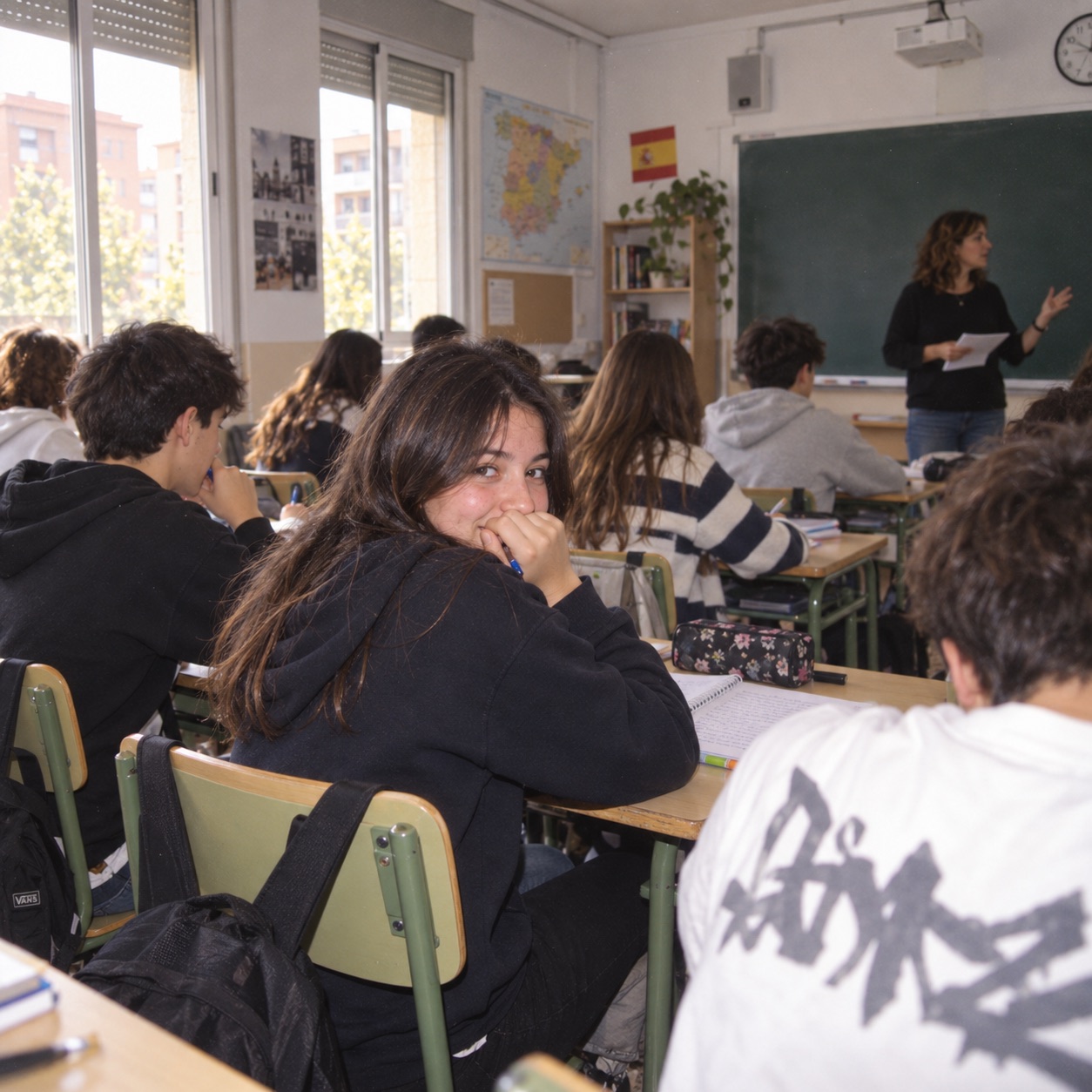
The household is part of the learning system.
What we found
The easiest way to read PISA is through the ranking.
We think that misses the more useful story.
Spain’s PISA 2025 performance was lower than in 2022 in mathematics and reading and broadly unchanged in science. The OECD notes that the 2025 results are below Spain’s 2015 results and among the lowest observed in the country across all three core subjects.
Spain also sits below the OECD average in mathematics, reading and science.
But PISA does more than test performance. It asks 15-year-olds about the context in which learning happens.
That context is where the family story begins.
Four signals around the score
Four numbers stand out.
54% of Spanish students say they use AI chatbots to help them learn at least once a week, compared with 46% across the OECD.
34% say they skipped at least one full day of school in the two weeks before the assessment, compared with 22% across the OECD. In Spain, that was 28% in 2022.
69% say a parent or guardian asks them at least once a week what they did at school. In 2022, the figure was 77%.
And 86% attend schools where mobile phones are banned on the premises, up from 67% in 2022.
None of these numbers, on its own, explains a PISA score.
Together, they describe a learning environment that is changing much faster than the traditional school debate.
The Famdom read
We keep talking about education as if learning happened in one place.
It does not.
A teenager learns in class, on YouTube, through an AI chatbot, in a WhatsApp group, with a tutor, beside a sibling, at the kitchen table and sometimes by asking a parent who has already had a long day.
Learning is distributed across family life.
So are distraction, motivation, permission, pressure, effort and support.
That means education companies cannot design only for “the student”.
The household is part of the learning system.
AI is already inside homework
The debate about whether students will use AI is over.
They already do.
In Spain, 54% of students report using AI chatbots to help them learn at least weekly. Students also report using them for preliminary research, summarising texts and drafting written assignments.
The useful question is no longer whether AI belongs in learning.
It is what role it should play.
If technology removes every moment of difficulty, it can also remove some of the cognitive effort through which learning happens. If it simply gives the answer faster, convenience can quietly replace understanding.
But AI can also explain, adapt, prompt, challenge and help a learner move forward.
The design question is therefore not AI or no AI.
It is: when should AI reduce friction, and when should learning be allowed to stay difficult?
More parental control is not the answer
The fall in reported family check-ins deserves attention.
In 2025, 69% of students in Spain said their parents or guardians asked at least weekly what they did at school, down from 77% in 2022. Weekly conversations about problems at school also fell from 60% to 50%.
But the answer cannot simply be to tell already stretched parents to supervise more.
Family-first education should make support easier.
Parents need to understand whether a child is progressing without having to become the teacher. They need useful signals, not another dashboard. They need moments where a conversation helps, not constant monitoring.
A good learning product should reduce the amount of detective work a family has to do.
Attention is becoming part of education design
Phone bans may reduce one source of distraction inside school.
They cannot solve the entire attention environment surrounding a teenager.
PISA 2025 reports that 86% of Spanish students attend schools where mobile phones are banned on the premises. Yet 29% still say classmates are often distracted by digital devices during most or all science lessons.
The broader challenge is therefore not simply the phone.
It is attention.
Education products now compete with feeds, games, messaging, creators, AI and every other system designed to make the next interaction easier than the current one.
Learning should be engaging.
But engagement is not the outcome.
Learning is.
Attendance is part of the learning environment too
A third of Spanish students say they skipped at least one full day of school in the two weeks before PISA.
That should not be read as one simple story about discipline.
Absence can carry very different realities: motivation, wellbeing, disengagement, family circumstances, school climate or something else entirely.
But for companies building around education, it is another reminder that the learner cannot be separated from the life around them.
A learning system that assumes perfect attendance, perfect motivation and perfect support at home is designing for a family that barely exists.
What education companies should take from PISA
PISA should not simply trigger another cycle of “scores are down” headlines.
For companies building for learners and families, it should trigger better questions.
Does the product preserve cognitive effort?
Can parents understand progress without becoming teachers?
Does it fit into real homework routines?
Does AI deepen learning or simply shorten the task?
Can the experience survive distraction?
Does it help a teenager build independence rather than dependency?
Does it still work when family life is messy?
Those questions sit between school and home.
Which is exactly why they matter.
What this means for family-first companies
The opportunity is not to add more educational content.
It is to design better learning systems around how families actually live.
That can mean clearer progress signals for parents. AI that prompts before it answers. Learning experiences that respect attention instead of exploiting it. Products that understand siblings, devices, homework routines and the uneven amount of support available at home.
The strongest education companies will not treat family context as an external variable.
They will design for it.
Inside this Debrief
- What Spain’s PISA 2025 results say beyond the ranking
- AI as part of the new homework routine
- Why parental involvement cannot mean more parental surveillance
- Attention as a learning-design problem
- Why attendance belongs in the wider family-learning picture
- What education brands should build differently for family life
Sources and verification
- OECD, PISA 2025 Results (Volume I): Spain, Country Note, 8 September 2026.
- OECD, PISA 2025 Results (Volume I): Student school life and beyond, September 2026.
- OECD, PISA Education and Skills dashboard, Spain.
Editorial note: PISA measures performance and reports contextual indicators; it does not establish that AI use, attendance, parental support or phone policies caused Spain’s score changes. The factual indicators above are OECD data. The interpretation and recommendations are Famdom Observatory’s editorial view.
Full Debrief
Get the full Debrief
Leave your details and the full Debrief is yours: the fieldwork, the three learnings and what a brand does with them.
Thank you.
The Debrief is on its way to your inbox.
That did not go through. Please check your details and try again.
Also in the Observatory
Questions about this piece
What do Spain’s PISA 2025 results show?
Spain’s performance was lower than in 2022 in mathematics and reading and broadly unchanged in science, and it sits below the OECD average in all three subjects. The Debrief argues the more useful story sits around the score: AI is already inside homework, absence is rising, digital distraction persists and fewer teenagers say their parents regularly check in on school life.
Why does PISA matter for education companies and family-first brands?
Because learning is distributed across family life, not confined to the classroom. The household is part of the learning system, so education companies cannot design only for “the student”. The opportunity is to design better learning systems around how families actually live: clearer progress signals for parents, AI that prompts before it answers, and experiences that respect attention instead of exploiting it.
How many Spanish students use AI chatbots to learn?
54% of Spanish students say they use AI chatbots to help them learn at least once a week, compared with 46% across the OECD. Students also report using them for preliminary research, summarising texts and drafting written assignments. The Debrief’s view is that the question is no longer whether AI belongs in learning, but when it should reduce friction and when learning should stay difficult.