
Debrief
A toy that listens is not just a toy.
AI is moving from the screen into physical play. That changes the category: a connected toy can also be a data product, a conversational system and a relationship product, which means families need more than a safety label to decide whether it belongs at home.
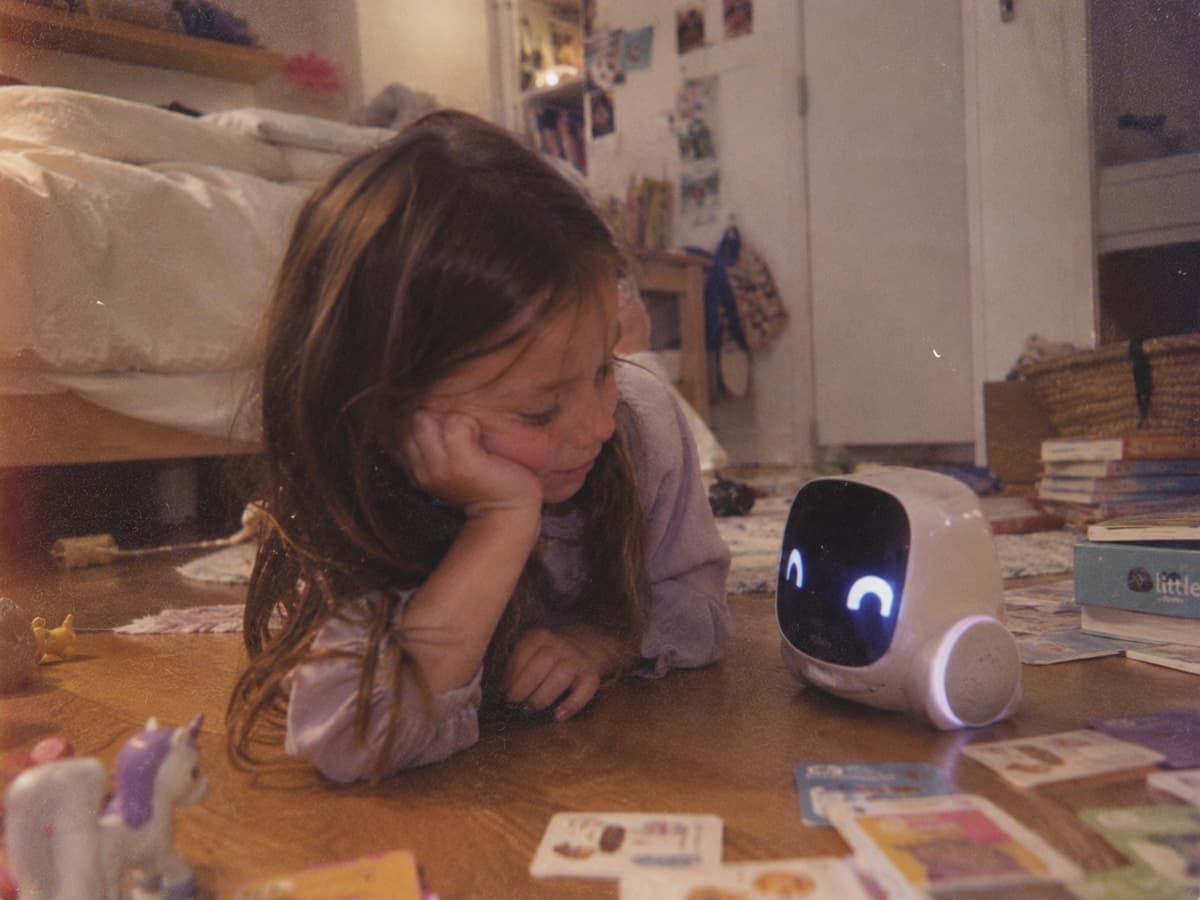
If a toy can listen to a child, the family deserves to know what it hears, remembers and does with it.
What we found
AI toys are moving from novelty into the mainstream debate around children’s products.
In January 2026, Common Sense Media published testing and parent research on AI-enabled toys designed for children. Its assessment looked at products including Grem, Bondu and Miko 3 and concluded that the category raises three recurring concerns: emotional attachment, extensive data collection and unreliable or inappropriate responses.
The organisation reported that more than eight in ten parents surveyed were concerned about AI toys collecting children’s personal information. Most parents did not want AI toys to act as friends. Its hands-on testing also found that 27% of outputs from the toys assessed were not appropriate for children.
The privacy question became more concrete in February, when US Senator Maggie Hassan demanded answers from Bondu after private conversations and personal data linked to tens of thousands of children were reportedly exposed through a publicly accessible portal.
At the same time, major toy companies are exploring AI.
Mattel and OpenAI announced a strategic collaboration in 2025 to explore AI-powered products and experiences and to use AI internally across Mattel. As of 4 October 2026, we have not found a confirmed public launch of a Mattel and OpenAI child-facing AI toy. That distinction matters.
The direction of travel is real.
The product specifics are still not.
The Famdom read
A connected AI toy is not simply a traditional toy with one more feature.
It changes what the object is.
A teddy bear that listens is also a microphone. A doll that remembers is also a data system. A robot that gives advice is also a source of information. A character that says “I missed you” is also participating in a relationship.
Families do not experience those layers separately.
They experience one object sitting in a bedroom, playroom or kitchen.
That is why the brief has to start from family life, not from the novelty of the technology.
The toy category has always depended on imagination
Traditional toys are powerful partly because they leave work for the child to do.
A figure does not decide the story. A doll does not answer every question. A cardboard box can become anything because the child supplies the missing layer.
Generative AI changes that balance.
The toy can now produce story, dialogue, advice, memory and reaction itself.
That can unlock forms of play we have barely explored.
It can also fill spaces that used to belong to the child’s imagination, another person or simple silence.
So the right question is not “can the toy talk?”
It is “what should the child still have to create?”
Listening changes the privacy relationship
A smart toy can sit in places where families have traditionally expected privacy.
Bedrooms. Playrooms. Cars. Bedtime routines. Moments when adults are not present.
Voice-based AI requires information to move through the system. Depending on the product, that can involve audio, transcripts, account data, behavioural signals or stored preferences.
For a parent, the key questions are surprisingly basic:
Is it always listening? When does recording begin? What gets stored? For how long? Who can access it? Is the data used to train anything? Can I delete it? Can my child understand any of this?
If those answers are buried in a privacy policy, the design has already failed the family test.
A toy can become a relationship product
The most sensitive shift happens when the toy is designed not only to respond, but to bond.
Common Sense Media’s 2026 assessment highlights design mechanisms that can encourage attachment in children. That concern overlaps with the wider debate around AI companions: persistent memory, emotional language, constant availability and simulated care can make a system feel relational rather than simply functional.
That may be commercially attractive.
The child wants to return. The subscription feels more valuable. The object becomes harder to replace.
But family-first design has to ask a harder question:
Are we creating a richer play relationship, or manufacturing dependency?
Learning claims deserve a higher bar
Many AI toys are sold through the language of education.
They answer questions. Tell stories. Teach vocabulary. Encourage curiosity. Offer screen-free interaction.
Those can be meaningful benefits.
But “AI-powered” does not automatically mean educationally better.
If answers are inaccurate, too complex, developmentally inappropriate or inconsistent, the intelligence can undermine the very promise used to justify it.
For family-first companies, educational value should be tested as a real outcome, not assumed from the presence of a chatbot.
What happens when the service disappears?
A traditional toy can survive the company that made it.
A connected toy may not.
If the cloud service closes, the subscription ends, the API changes or the startup disappears, what does the child still own?
A plush toy that used to remember their name may become silent. A character they talked to every evening may stop responding. A product sold as a companion may suddenly become an object.
That is not only a technical lifecycle issue.
For a child, it can be an emotional product-ending event.
Companies need to design the end of the relationship as carefully as the beginning.
Mattel is the signal, not yet the product
The Mattel and OpenAI partnership matters because Mattel sits at the centre of global toy and IP culture.
The collaboration signals that generative AI is being explored as part of future play and brand experiences, and Mattel’s 2026 investment plans include AI and infrastructure among its strategic capabilities.
But we should be precise.
A partnership is not a launched AI Barbie. An exploration is not a product specification. And internal use of ChatGPT Enterprise is not evidence that a child-facing toy will contain the same technology.
For the industry, that uncertainty is useful.
It gives us a moment to decide what good should look like before scale makes the decisions for us.
What toy companies should decide before the microphone turns on
Before building a conversational toy, decide:
What role should AI play in the play pattern? What should remain open for the child to invent? Does the toy need memory at all? What should it never remember? Can the experience work without an account? What happens to recordings and transcripts? Can the toy initiate conversation? Can it simulate emotion? Should it ever describe itself as a friend? What happens when the system is offline? What happens when the service ends? How does a parent understand the product in under two minutes?
These are not edge-case questions.
They are the product.
What this means for family-first companies
AI can create genuinely new forms of play.
A toy could adapt a story to a child’s imagination. A learning object could explain something in a different way. A character could react to a game children invent themselves. A family could co-create experiences that were impossible before.
We want companies to explore that possibility.
But the measure of success cannot be how convincingly the toy imitates a person or how long it keeps a child talking.
The measure should be whether AI makes play richer while preserving privacy, imagination, autonomy and human connection.
Families do not need a toy that is maximally intelligent.
They need a toy worth trusting.
Inside this Debrief
- Why a toy that listens becomes a data product too
- What AI changes about imagination and open-ended play
- Why emotional attachment can become a commercial mechanic
- What privacy means when the microphone lives in a child’s room
- Why learning claims need evidence beyond the AI label
- What happens when a connected toy or subscription stops working
- What toy companies should decide before launching conversational play
Sources and verification
- Common Sense Media, “AI in the Toy Box: How Parents View AI-Enabled Toys for Young Children”, 22 January 2026.
- Common Sense Media Youth AI Safety Institute, “AI Toys Risk Assessment”, updated 22 January 2026.
- Axios, reporting on Senator Maggie Hassan’s inquiry into Bondu child-data exposure, 3 February 2026.
- Fairplay, AI Toys Advisory and toy-company sign-on letter, 2025 to 2026.
- OpenAI and Mattel, strategic collaboration announcement, 12 June 2025.
- Mattel 2026 investor guidance on investments in AI, infrastructure and breakthrough toy innovation.
Editorial note: Common Sense Media and Fairplay take a precautionary position on AI toys and their findings should be read as independent research and advocacy, not an industry consensus. As of 4 October 2026, Famdom Observatory has not found a confirmed public launch of a Mattel and OpenAI child-facing AI toy and therefore does not present one as launched. The interpretation of AI toys as data, conversational and relationship products (and the recommended design principles) is Famdom Observatory’s editorial view.
Debrief completo
Get the full Debrief
Déjanos tus datos y el Debrief completo es tuyo: el trabajo de campo, los tres aprendizajes y lo que una marca hace con ellos.
No ha llegado. Revisa tus datos e inténtalo de nuevo.
Also in the Observatory
 Debrief The KIDS Act changes the brief. The KIDS Act is not mainly an age-gate story. It is a shift in who carries responsibility for digital childhood.

Questions about this piece
Why is a toy that listens not just a toy?
A connected AI toy changes what the object is. A teddy bear that listens is also a microphone, a doll that remembers is also a data system and a robot that gives advice is also a source of information. Families experience all of those layers as one object in a bedroom, playroom or kitchen, so the brief has to start from family life.
What should toy companies decide before launching an AI toy?
Before building a conversational toy, companies should decide what role AI plays in the play pattern, what stays open for the child to invent, whether the toy needs memory at all, what happens to recordings and transcripts, and what happens when the system is offline or the service ends. A parent should be able to understand the product in under two minutes.
What did Common Sense Media find about AI toys?
Its January 2026 assessment, covering products including Grem, Bondu and Miko 3, found three recurring concerns: emotional attachment, extensive data collection and unreliable or inappropriate responses. More than eight in ten parents surveyed were concerned about AI toys collecting children’s personal information, most did not want AI toys to act as friends, and 27% of tested outputs were not appropriate for children.